

Tour New Zealand: land of the long white cloud

In a bid to flee a freezing Norwegian winter, Runa Grydeland goes in search of a summer adventure in New Zealand. And, despite travelling to the other side of the world, she discovers a spectacular land of mountains, fjords, and stunning coastlines much like her home, although this one is bathed in sunshine.
February on the southwest coast of Norway is cold and wet. There is a layer of snow in the streets outside. Not the pure white fluffy kind of snow you might envision when you think of winter in Norway.
Instead, it’s the grey, wet, and dirty kind that has turned to slush because of all the salt being sprayed on the roads. Most motorcycles are parked indoors somewhere warm, and helmets and riding boots are tucked away in the back of closets to make way for warmer winter clothes and skiing boots. The motorcycle season is still months away, and PMS (Parked Motorcycle Syndrome) is at its most prevalent.
But not everywhere. If you were to peek through the window of a little house on this snow-covered street on the evening of the February 11, you would spot a chaotic mess of motorcycle and camping gear, summer clothes and camera kit floating around, half packed and charging wherever there is a surface or power outlet available.
And in the middle of all this mess, you would witness someone running around like a headless chicken trying to locate her passport, organising her travel documents and scrubbing her motorcycle boots and tent pegs in the shower? What the…?
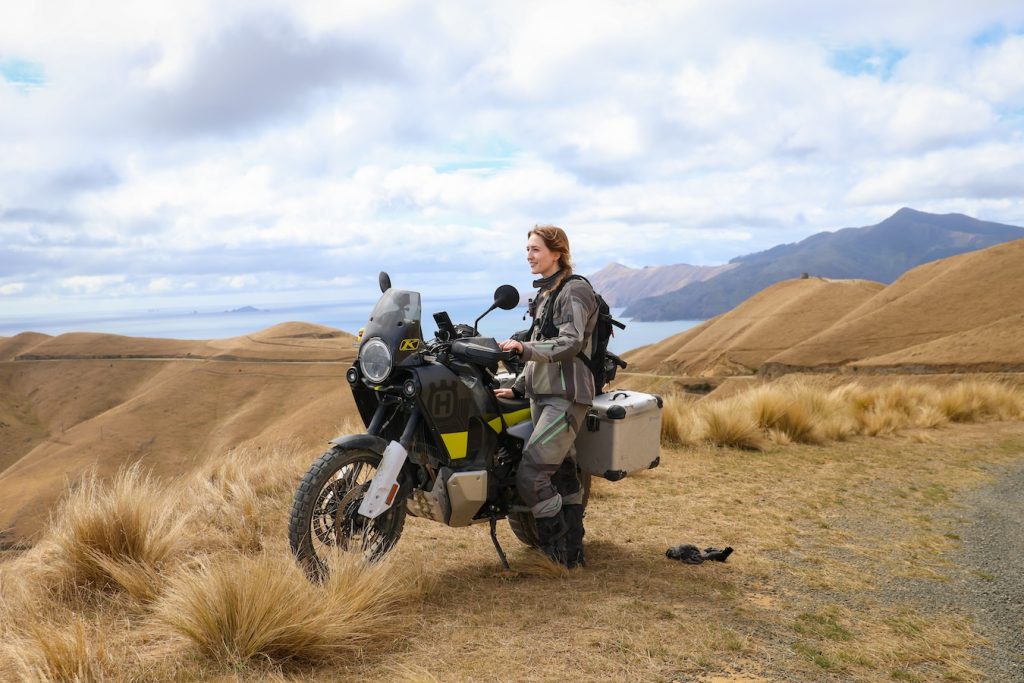 Runa admires the views of French Pass
Let me explain. Hi, my name is Runa, and that mad woman trying to get ready for a trip to New Zealand was me. And no, it was not last-minute decision to travel there. My ticket was booked two months prior to departure. I’m just exceptionally good at leaving things to the last minute, which includes packing. And with a maximum load of 30kg to fit all my riding gear, camping, and camera gear, packing turned out to be a bit of a challenge.
Oh, and did I mention New Zealand’s strict biosecurity requirements where your outdoor gear has to be squeaky clean and pass an inspection upon arrival? Hence the scrubbing of boots, tent pegs, and everything that could possibly have some dirt left on it from my past trips.
With the packing finally completed, I sit back on my couch just staring at my bags with butterflies in my stomach. Actually, they feel more like magpies: big, loud, and a bit annoying but if you look closely, kind of beautiful.
I’ve wanted to travel to New Zealand for as long as I can remember and, all of a sudden, the day I’ve been counting down to for the past two months is just hours away. But why New Zealand? There are mountains and fjords in my home country, Norway, so why bother travelling to the other side of the world for what I already have in my own backyard?
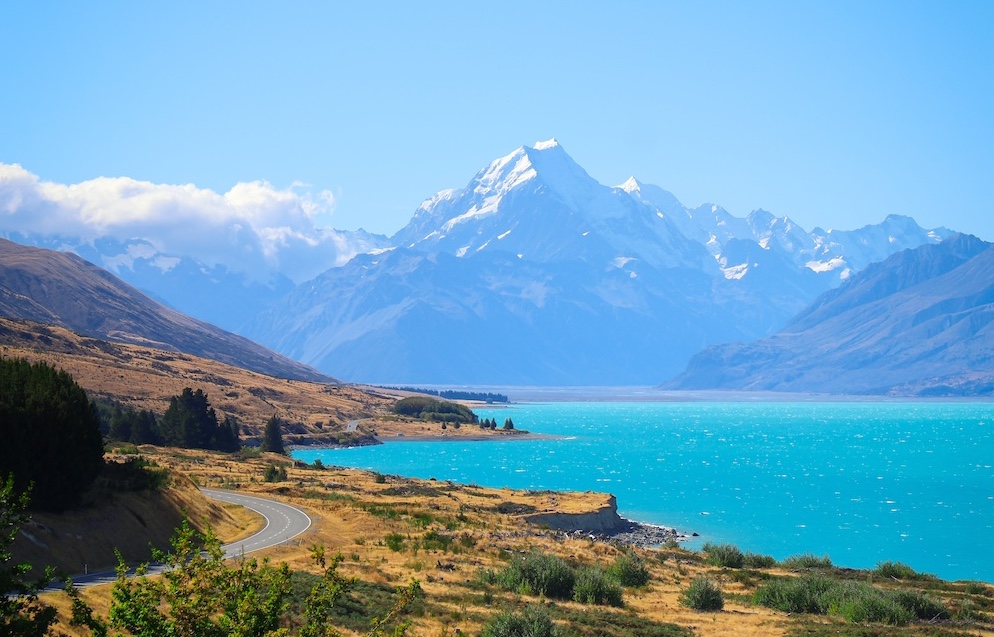 A spectacular view of Mount Cook and Lake Pukaki
I’ll tell you why. Because New Zealand has something Norway does not have in February: summer. Let’s just hope it doesn’t live up to its Māori name, Aotearoa, or Land of the Long White Cloud. I want some sunshine!
I’m in frickin’ New Zealand
So, 36 hours after take-off, my flight touches ground in Auckland, situated on the northern part of New Zealand’s North Island. Together its South Island, the country stretches for just under 1,000 miles through the South Pacific Ocean, approximately 930 miles southeast of Australia, its nearest neighbour.
With just over 5.2 million people sharing almost 104,247 square miles, it’s far from overly crowded which I happen to appreciate a lot. I also like the fact that, unlike its neighbour Australia, there are close to zero creepy crawlies, big or small, that could potentially kill you.
A couple of hours, and one taxi ride later, I find myself at the headquarters of Husqvarna Motorcycles New Zealand. There is a brand new Norden 901 parked up out front that will be my companion for the upcoming month. I’m in the fortunate position to be able to borrow a bike from Husqvarna as I’ll also be filming a series of videos of my trip for my YouTube channel, Off She Goes.
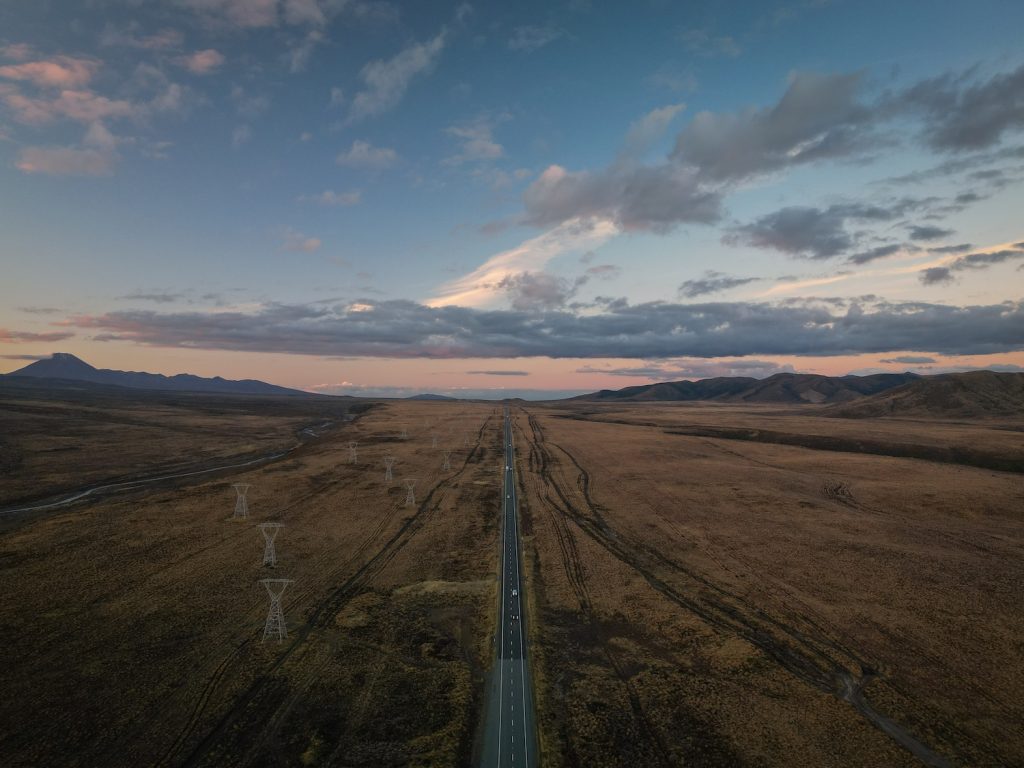 An arrow-straight road through a desert-like landscape took Runa across the North Island
Next up is the unavoidable part of this trip that I have been the most nervous about. In 1835, Great Britain made it mandatory to drive on the left side of the road. All members of the British Empire followed suit, and even though New Zealand is no longer under British rule, it maintained this practice. I’ve never driven on the left side before, and being someone who is very easily distracted, with 70 different thoughts constantly spinning in my head, I’m sure this is going to be a total shit show.
With Google Maps ready on my phone perched on the handlebars, and voice commands in my ear through my Cardo headset, I head off. To my surprise, as is often the case, all my earlier worries prove unnecessary. I navigate my way out of the city with ease, and soon find myself on Highway 1, heading south.
Isn’t it funny how the all the worry I feel leading up to a trip disappear like dust in the wing mirror as soon as I’m riding the bike and on my way? I know you can relate. All stress melts away and is replaced with an ‘oh well, whatever happens, happens’ attitude. I love this part about travelling.
The North-South divide
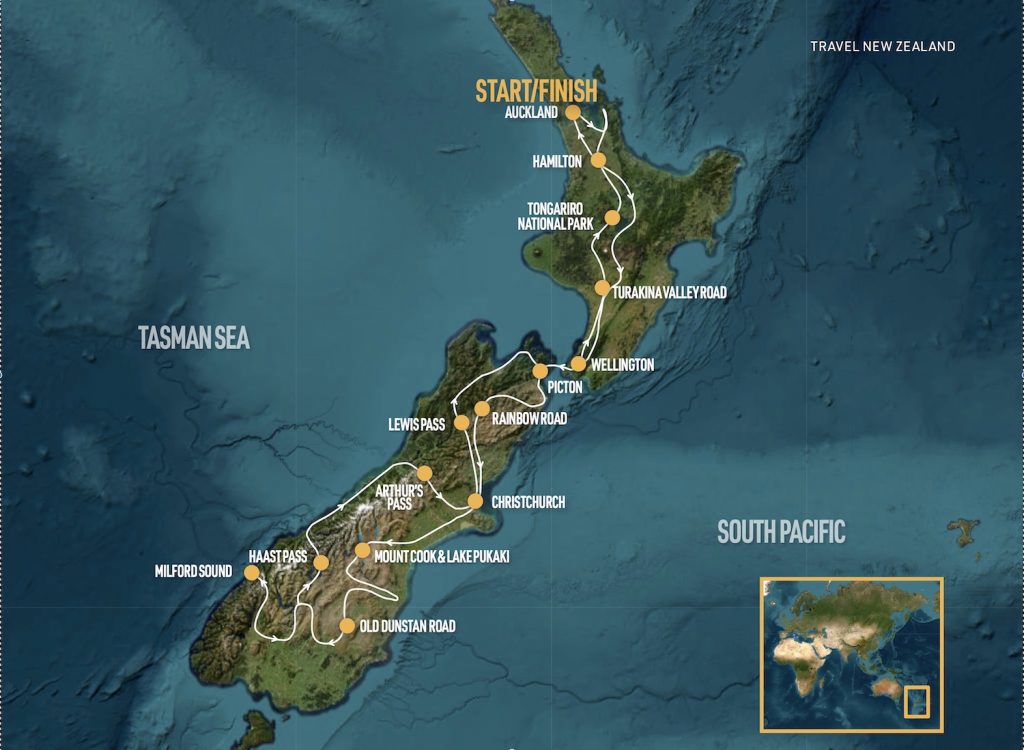
I spend my first night at a campsite in Tongariro National Park, west of the volcanoes at Mount Ruapehu. Yup, New Zealand is a volcanic island and there are a whole bunch of them, both inactive ones as well as a few that are still very much alive. The most recent big eruption happened in December 2019 which claimed 21 lives and injured even more people. But let’s not dwell too long on that.
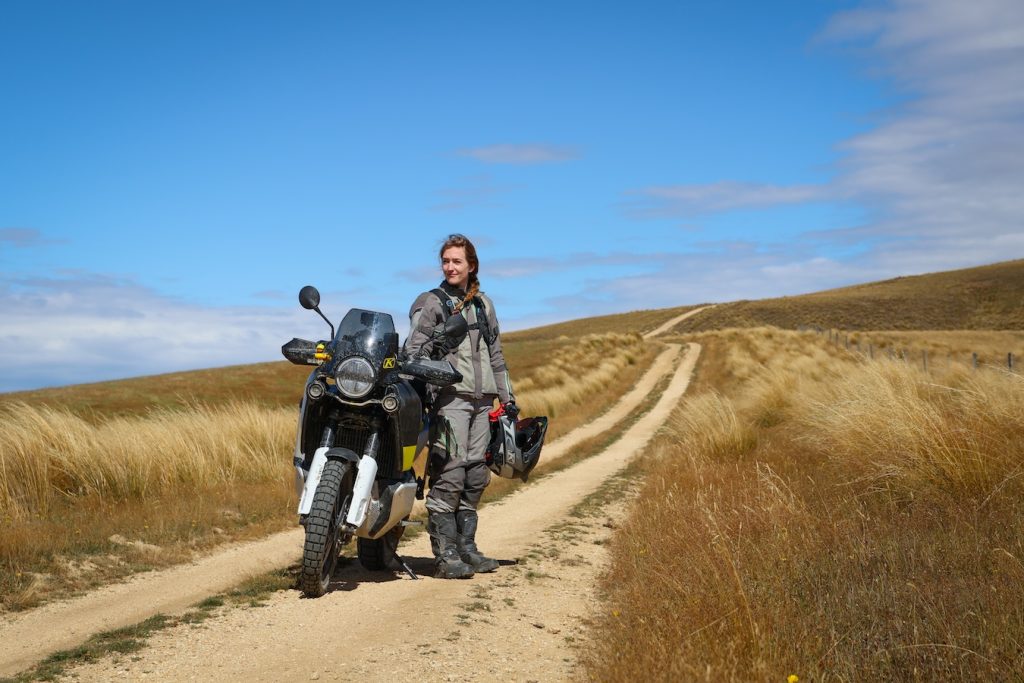 Taking a breather on the Old Dunstan Road on the South Island
The next morning, before I can even open my eyes inside my tent, I can hear the summer outside. A slight breeze is ruffling the leaves on the trees around me, and I’m surrounded by the sound of birdsong. It’s a different tune to the ones I’m used to in northern Europe, but yet so familiar.
Have you ever wondered why birdsong is so relaxing? I have, so I did some reading and like most things it has a very logical answer. Research has revealed that when we hear birds chirping, it’s a signal that there are no predators nearby. Birds sing only when they feel safe. This means the sound of bird song serves as a sign of peace and safety, tapping into our primal instincts and signalling to our nervous system to relax. Amazing, isn’t it?
Feeling wonderfully relaxed myself and prepped with sunblock to protect my pale winter skin from the harsh sunlight caused by the thinner ozone layer above New Zealand, I took the Turakina Valley Road southwards. It’s a twisty little road with a mix of gravel and tarmac that follows the meandering path of the Turakina River.
Accompanied by green, rolling hills and a blue sky with perfectly puffy little white clouds, I enjoy the feeling of exploring a new country for three hours or so, until I find myself riding through the suburbs of New Zealand’s capital city, Wellington which sits at the southern tip of the North Island.
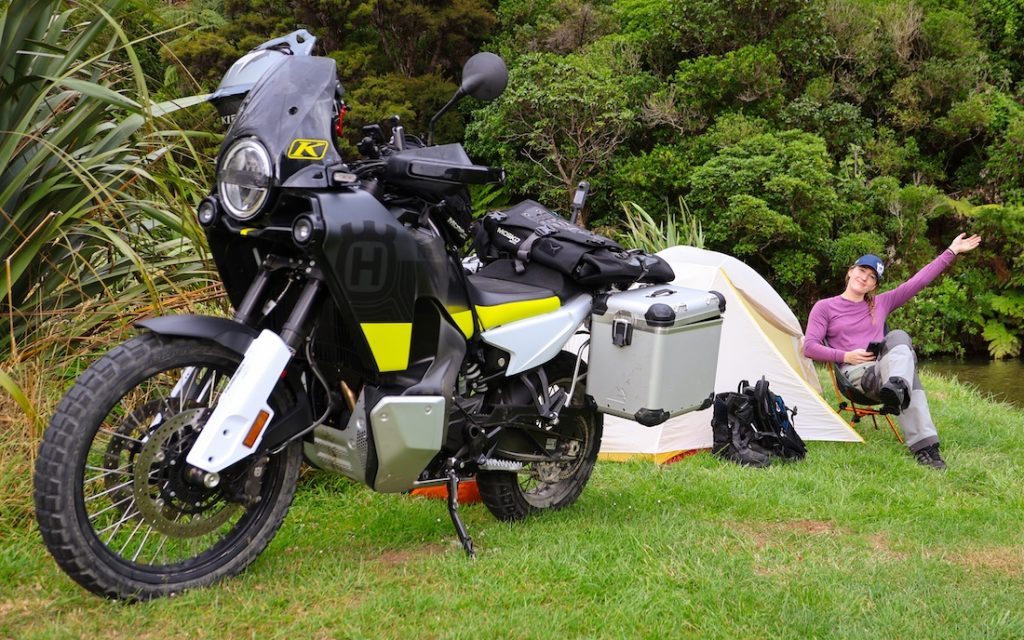 Runa’s first night camping on the South Island, shortly before her first sandfly encounter
Making my way to the harbour, I ride onto the ferry that will take me on the three-and-a-half hour sailing across the Cook Strait. I’m no stranger to ferry rides with my bike, as we have plenty of those in Norway.
The Rainbow Road
Just as the sun starts to set, I roll off the ferry at Picton and make my way to Whatamango Bay Camping Area, my first of soon to be many encounters with the simple, unmanned and affordable Department of Conservation (DoC) campgrounds.
As I pitch my tent right next to a small river, I also have my first encounter with a tiny little black fly that I have been warned about: sandflies. Never in my life have I experienced an itchier insect bite. Consider yourself warned.
While doing research on my route back home, there was one stretch in particular that kept being recommend: the Rainbow Road, a 70-mile unpaved road well known for its scenic landscape. The start of is less two hours away so it’s a natural choice to take me further south.
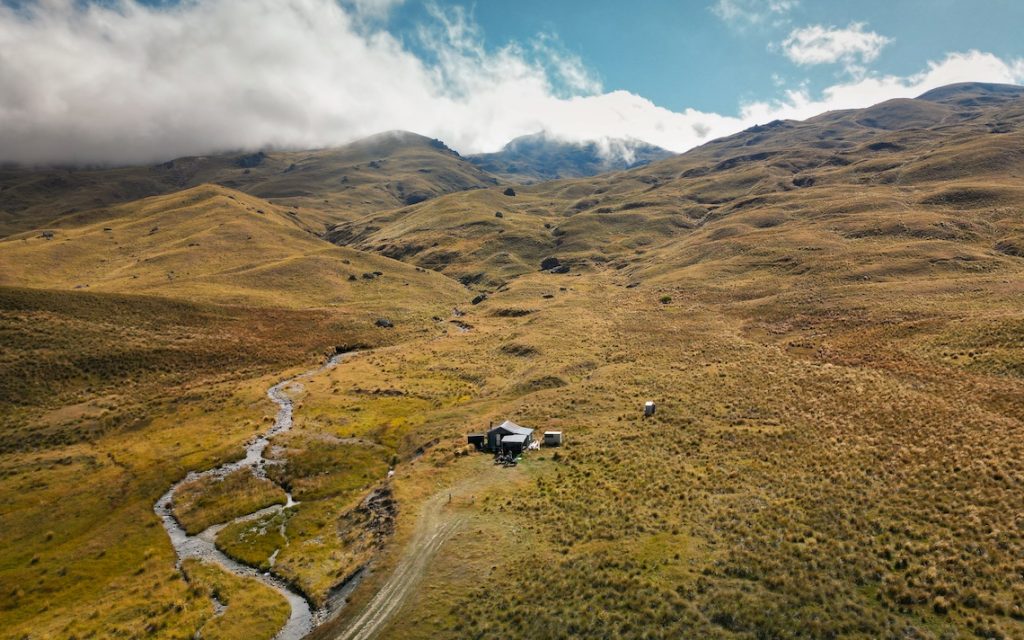 The challenging but spectacular Nevis Road is not an officially recognised road, so ride it at your risk
As it turns out I’m not the only adventure biker drawn the road less travelled. Kinga Tanajewska, from the YouTube channel On Her Bike, happens to be in the part of New Zealand too so we get in touch online and decide to meet up and spend a night camping together.
The Rainbow Road is every bit as spectacular as the photos promised with a landscape that keeps changing. From flowy grassy fields, to rocky, mountainous areas, gorges and valleys, there isn’t a dull moment for the eye or the bike.
I successfully complete my first river crossing and the meet-up with Kinga about halfway along Rainbow Road where we find ourselves a perfect little camping spot by a river. There is little to no phone service, and we feel remote and alone, which is wonderful way to be on a motorcycle adventure.
Kinga and I join forces for a couple days, visiting the thermal pools at Hanmer Springs before continuing to the biggest city on the South Island, Christchurch, where I my bike is given its 1000km (621 miles) service.
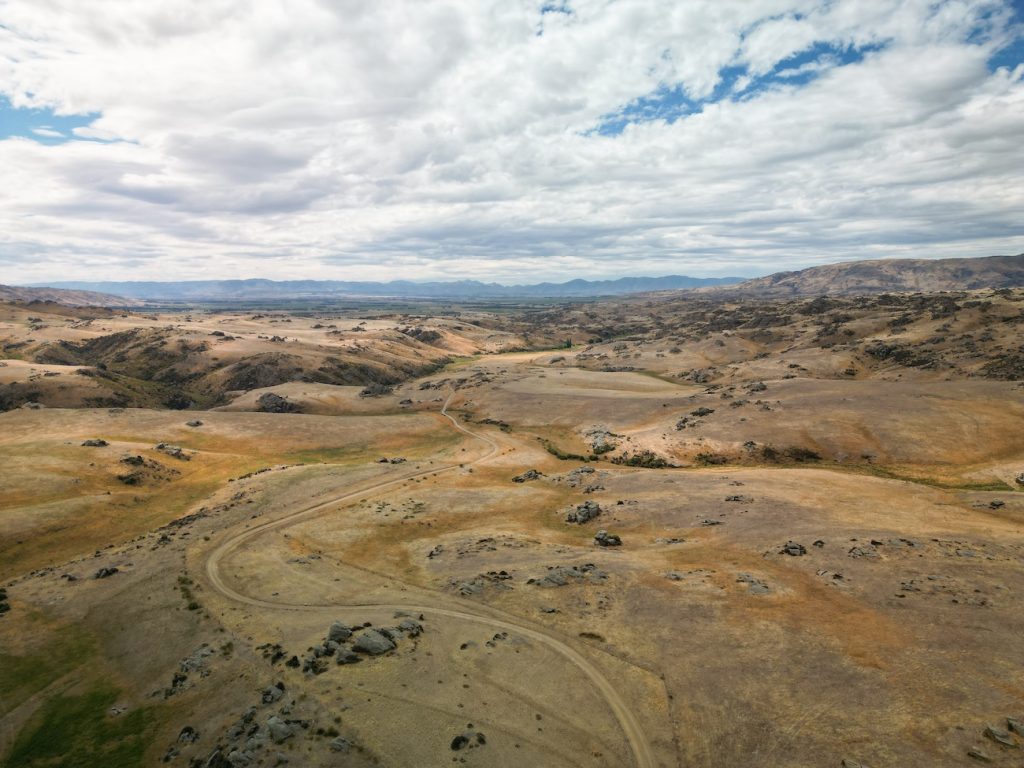 Old Dunstan Road, the second-longest stretch of unpaved road on Runa’s tour
We end up staying with Will, another world traveller we meet who has many tales to tell. There are few things that are more inspiring and motivating than listening to the stories of people who have travelled so far and wide, and here I was with two of them.
Going solo
With the weather forecast promising good weather on the west coast for the next few days, I jump eagerly on the bike, parting ways with Kinga and Will.
Along the South Island there is a chain of mountains called the Southern Alps which I cross through Arthur’s Pass, and it feels awesome to be surrounded by mountains again. I’m constantly watched over by the jagged peaks and glaciers poking through the low hanging clouds.
I make my way back across the Southern Alps again though the spectacular Haast Pass and spend a night camping under a vast sky filled with stars, with the moon illuminating the snow-capped mountain peaks.
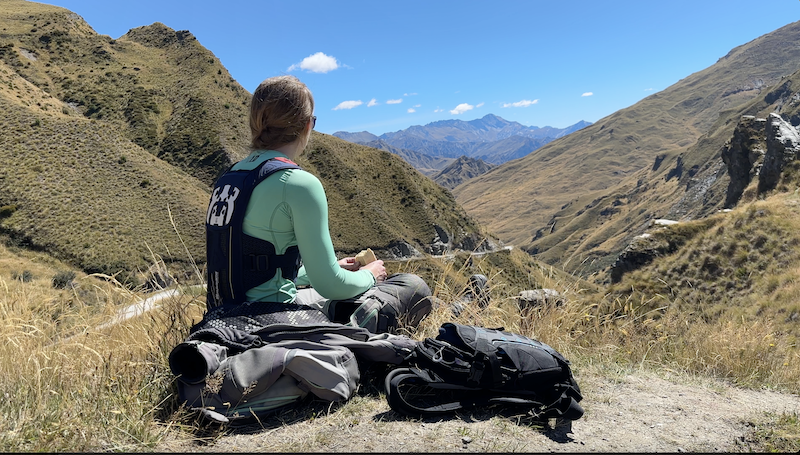
Runa enjoying the view, and some pie, in Skippers Canyon
Did you know New Zealand offers some of the best stargazing in the world? It needs to be seen to be believed. There is very little light pollution compared to other countries, which makes it a magical experience. Finally dragging my eyes away from the nightscape, and I get a good night’s sleep and start the next day by putting Skippers Canyon into my SatNav.
Known for its beautiful and dramatic scenery (this isn’t uncommon in New Zealand) it’s also considered one of the country’s most dangerous roads. Hacked out from the sheer cliffs by miners over 140 years ago, it’s an unpaved, narrow route with no railings and a river below.
It sounds like just the sort of challenge I enjoy. I am all about pushing my limits and getting out of my comfort zone to develop both as a rider and an individual. However, I’m also on these trips to enjoy myself and, being scared of heights, this road was not for me. I ended up turning around about halfway, too nervous to relax with my heart racing.
Instead, I found a spot to enjoy the immense views from a safe sitting position, consuming a rather delicious pie. It turns out New Zealanders are quite crazy about pies, and you’ll find an assortment of them pretty much everywhere.
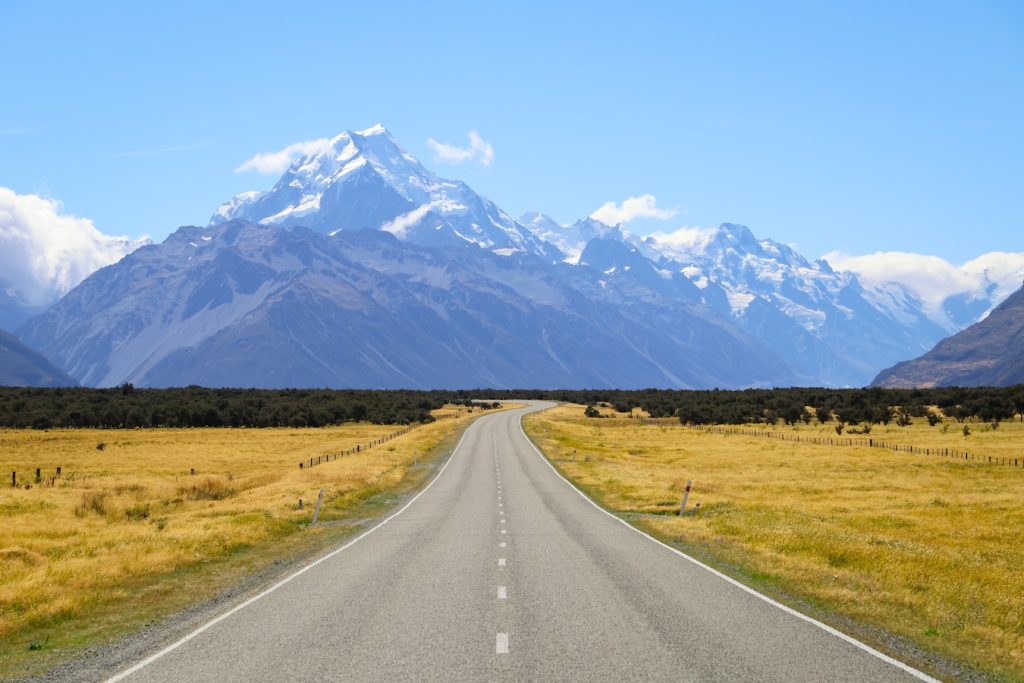
Mount Cook on the South Island is 3,724m high, making it New Zealand’s tallest mountain
Fjords and mountains
Over the next few days, I visit Milford Sound in the famous Fiordland National Park, which is the part of New Zealand that is said to look most like my home country Norway. The fjords and the steep, rugged mountains definitely hold a similarity to the Norwegian landscape, while the tropical vegetation covering the mountainsides made it very different at the same time.
From the lush and tropical Fiordlands, I transition back to the drier, prairie-like landscape of the east of the South Island. I passed Mount Cook, New Zealand’s highest mountain with Lake Pukaki at its base, the most spellbinding, turquoise lake I have ever laid my eyes upon.
But as beautiful as it is, I’m very excited to take on the Old Dunstan Road, the second longest stretch of unpaved road on my trip and, on this day, it offers hours of lone riding. I know that being alone and far from anyone else can cause worry and unease but, for me, I just feel calm and at peace.
Imagine this: you’re on an old dirt road and, as far as the eye can see, there are just fields of yellow and orange grass. Big, black volcanic rock formations are popping up here and there, and there are huge mountains far off on the horizon. You have the whole day at hand. There’s nowhere you have to be at a certain time and no one expecting anything from you. You come to a halt, stop the engine, and get off the bike.
Take off your helmet and you hear… nothing. Well, almost. There is the warm breeze ruffling the dry grass and some insects buzzing. You can hear your own heartbeat and your own breathing. The silence is loud. Pure perfection.
It’s hard to pull myself away from this paradise, but I can’t stay here forever. Sadly, time is passing way too fast and before I know it, I have to slowly start to making my way north again to catch my flight out of Auckland.
Along the way I seek shelter in Christchurch with Will once again as a storm strong enough to tear off roofs from houses passes over the island. A day later I make my last ride through the southern alps over the Lewis Pass where I set up camp and fall asleep to the sound of heavy rain.
As I wake up the next morning, ice has formed on my tent. My motorcycle bags are frozen solid and my breath is turning white from the cold. Brrr!
There is fresh snow on the mountain tops which is all a reminder that, while summer is approaching at home in Norway, it’s also leaving New Zealand.
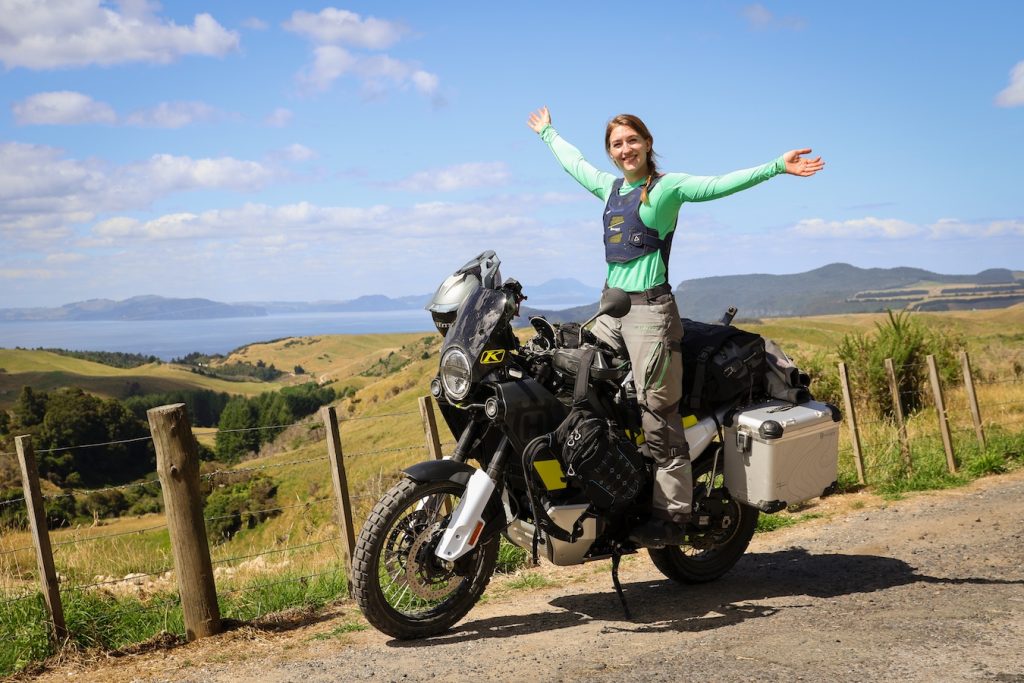
Runa greeting the challenge of riding on the left side of the road with open arms
It’s funny how my mindset changes once I know my time is almost up on a trip. I thought one month was plenty of time to explore a relatively small country, but no matter how long I set aside on a trip, it’s never quite enough. There is always more to see, and the closer I get to end, the more important it feels to try and soak up every little moment and impression, so that I can take home as many memories as possible.
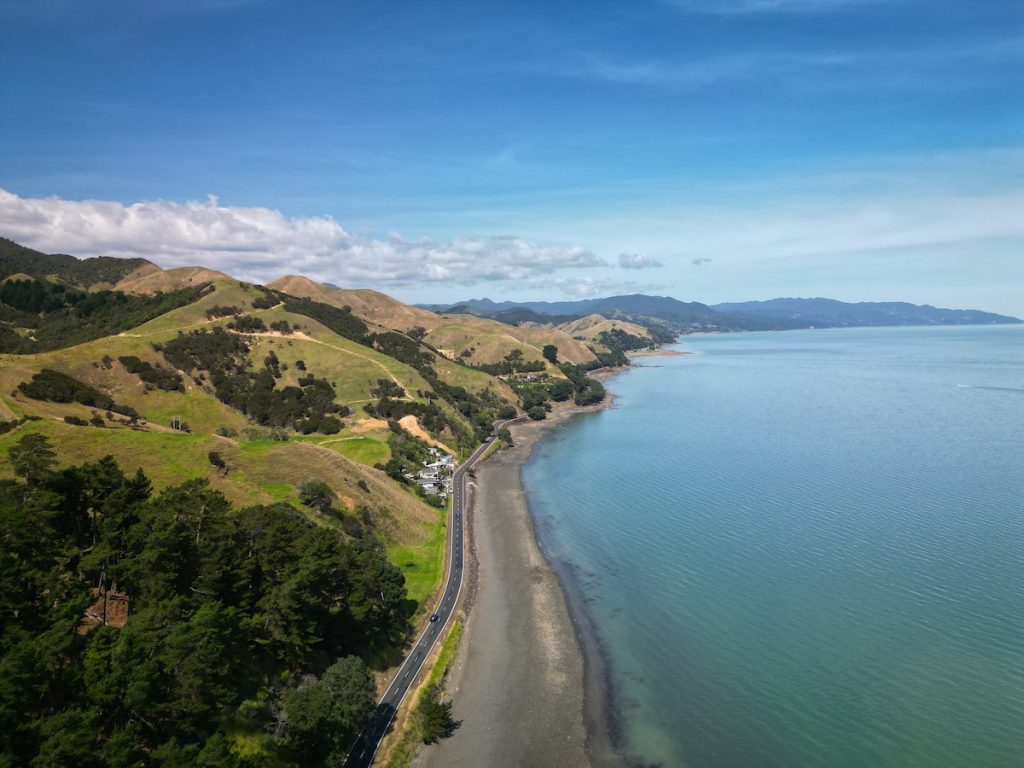
Riding the magnificent French Pass on my last full day on the South Island is when this feeling hits me the hardest. Being surrounded by such beauty on all sides, I simply don’t want to let it go. But perhaps this is a good thing, to be left hungry for more.
Three starry nights later, after a rather hasty ride and ferry crossing back up north, I complete my 3,730-mile trip through New Zealand. With the bike delivered back to Husqvarna New Zealand, I head home to Norway. Luckily the end of one adventure only marks the beginning of the next, and as I arrive home with spring just around the corner, and another motorcycle season opens up before my eyes. Let the adventure continue.
Who’s writing?
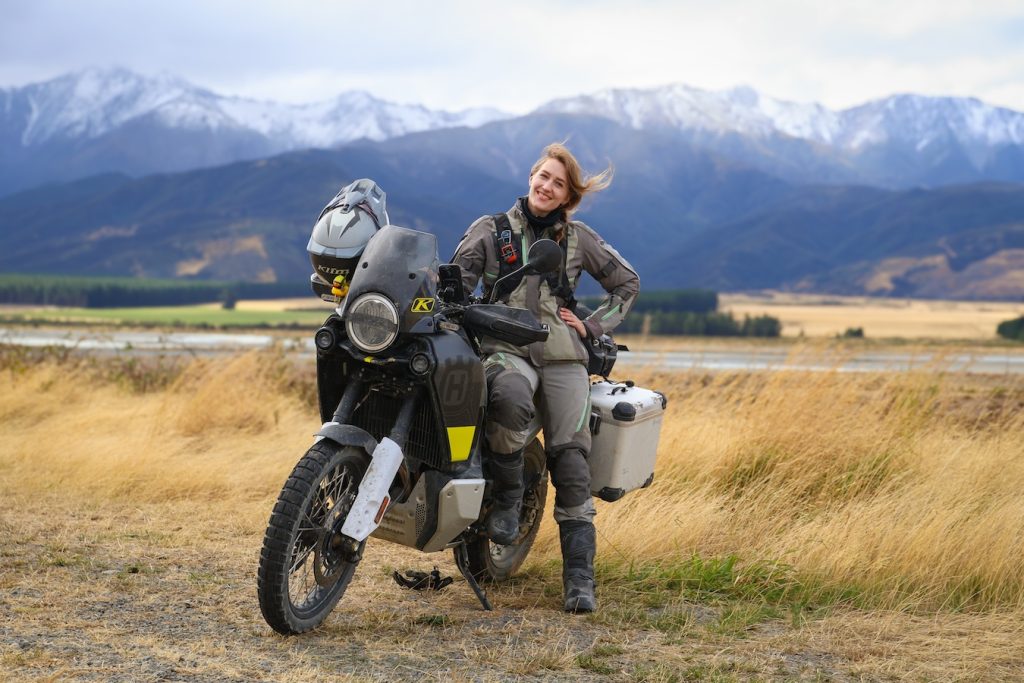
Hi, I’m Runa Grydeland, a 30-year-old Norwegian with a passion for motorcycle travel. I got my motorcycle license in 2020, and I’ve been hooked ever since.
In 2023, I took a leap of faith and left my career as a nurse to become a full-time content creator. On my YouTube channel, Off She Goes, I share my motorcycle adventures, aiming to inspire others to explore the world, or simply their neighbourhood on their bikes.
Through my content, I want to show that you don’t need to be an expert rider or travel to far-off places to have incredible experiences. My goal is to encourage people to slow down, enjoy the journey, and find joy in the simple moments on the road. You can find out more about my adventures on YouTube @OffSheGoesADV and on Instagram @runagrydeland.
The bike
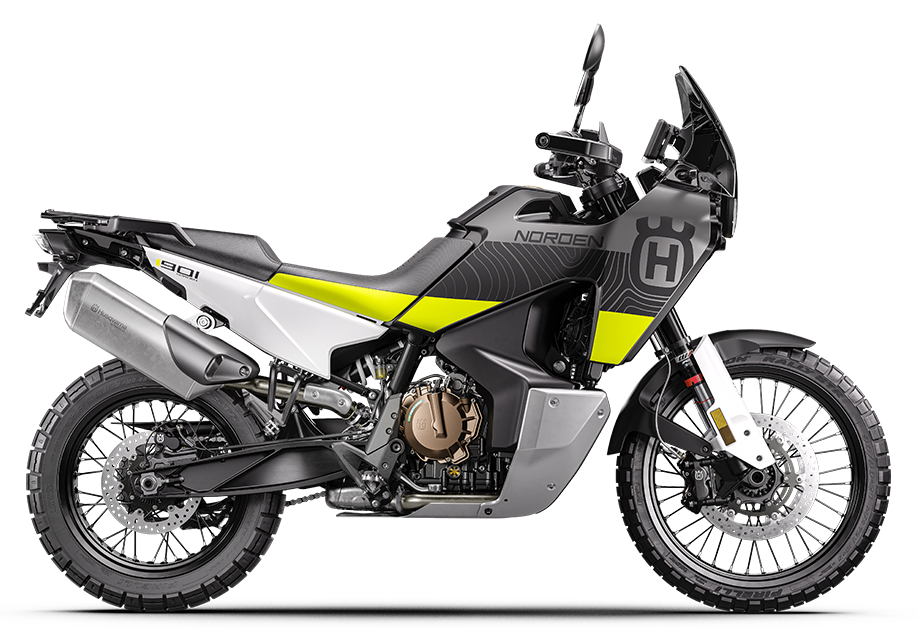
During my travels in New Zealand, I rode a Husqvarna Norden 901, a bike I’ve grown familiar after becoming an ambassador for Husqvarna Motorcycles Scandinavia.
The bike was soon named Kiwi by my Instagram followers, and together, we covered around 3,730 miles across a mix of on-road and off-road terrain.
It was the perfect companion for my adventures, built to handle both the challenging and scenic routes I encountered.
Want to ride in New Zealand?
If you’re from the UK, you can travel to New Zealand without a visa for up to six months, although you will need to get a New Zealand Electronic Travel Authority which you should apply online for before you travel.
Be aware of New Zealand’s strict biosecurity regulations so clean your gear thoroughly before arrival, especially if it has been used outdoors.
You’ll be riding on the left side of the road, which won’t be a problem for you Brits, but for the rest of us, it can prove a challenge.
New Zealand’s Department of Conservation (DoC) offers simple, affordable campsites in stunning, less-crowded locations which are perfect for motorcycle travellers. They cost around £10 per night.
Alternatively, a hostel bed will set you back £15-£25, and a nice hotel around £80 for a night. The average price of a pint is around £5.
Expert tips for riding New Zealand
If Runa’s journey around New Zealand has whetted your appetite, then check out these top tips from three of the world’s leading experts on touring in the country.
Know the roads
By John Fitzwarer from GoTourNZ
We’ve always made going off the beaten track the main theme of our guided and self-guided tours, exploring small towns, lodges, backroads and some legal gold-rush-era towns like Clyde, Oamaru, Raglan.
However, if you are renting a bike or taking a self-guided tour, be sure to tell the bike supplier which route you plan to ride on your tour.
For example, The Nevis and Rainbow Roads ridden by Runa on her trip are not officially recognised roads and therefore bike insurance is voided. Ditto riding on beaches like 90 Mile Beach in the far north, or Oreti Beach near Invercargill.
Some companies also void insurance on Skipper’s Road, which was also ridden by Runa. Best to ask the experts first.
It’s worth booking any ferries you plan on taking well in advance. I’d recommend booking at least a month in advance, or else be prepared to wait on standby for up to three days in peak demand periods.
I’ve been leading and arranging tours across New Zealand for the past 28 years and showing off the best of the country means knowing the most exhilarating and beautiful roads to take, as well as knowing the ones that could get an unwary newcomer into legal trouble.
Aside from the legal issues of riding non-gazetted roads, I’d also avoid what I call ‘conveyer belt’ highways, for example State Highway 1, although the section from Cheviot to Blenheim is worth riding. If you’re coming all the way to New Zealand, you may as well seek out the very best roads.
My personal favourite ride? The 182-mile route from Franz Josef to Wanaka on SH6: glaciers in sub-temperate rainforests, an alpine pass, rocky coastal sections, twisting mountain lakeside roads, high desert grasslands, then more alpine lakes. It’s like the scenery and landforms of every continent have been packed in for the sole benefit of motorcyclists. Fantastic.
Know the climate
By Lance and Sally Mitchell from Open Road NZ
Our seasons are a complete reversal to the UK which is great if you want to escape your winter. Mid-spring to late autumn (October to April) are the best for riding.
Having said that, we do have clients coming to the North Island to ride pretty much all year round.
The upper parts of the North Island are subtropical. It never snows up here, with maybe a couple of frosts each winter. It’s very green and lush and can get warm in summer (28-30C), although it can feel warmer due to the humidity.
You can ride here all year round, and if you ride in a UK winter, our North Island winters are very mild in comparison. Of course, the central part around Lake Taupo and Rotorua are where our ski fields are, so they do get cold in winter.
The South Island, like the North, is also long and fairly narrow but that’s where the similarities end. It generally has higher temperatures in summer and it’s a lot colder in winter, with plenty of snow.
It’s not so humid, although it can experience higher temperatures than the North Island in the summer.
The scenery is mostly big and dramatic, and the west coast of the South Island is also known as the ‘wet’ coast for obvious reasons. It still feels very remote and sparsely populated because it is.
The centre has a mountain range called the Southern Alps with loads of great rides over them, but it’s best avoid the South Island in winter if you’re planning to ride.
Since you’re never more than 125 miles from the sea on either island and the weather can be completely different from one coast to the other, always be prepared for changing weather.
Layers are your friends, and expect four seasons in one day. Choose gear that has ventilation and provide good air flow, but good waterproofs are also essential.
Most of all, take your time, meet the people, enjoy the food, soak up the scenery, and experience the wild side of New Zealand.
Know the islands
By Steve Gillies from Kiwi Motorcycle Rentals
You can think of New Zealand like this: the North Island is the louder, livelier older sibling with geothermal wonders, volcanic peaks, more towns, and more culture.
In comparison, the South Island is the quieter, more dramatic younger sibling with serious good looks. There are fewer people, bigger mountains, and roads that feel like they were designed specifically for motorcyclists to ride.
Highlights of the North Island include the Bay of Islands, the Coromandel Peninsula (which is riding nirvana), and the bubbling geothermal madness of Rotorua.
Meanwhile, the South Island has snow-capped alps, mirror lakes, empty highways, coastal twisties, and rainforests that rival the Amazon, except they come with good coffee and no snakes.
If you’re coming all the way from Europe with limited time, we suggest prioritising the South Island for bang-for-your-buck in the scenery department.
The typical tourist coach route hits all the heavyweights: Rotorua, Queenstown, Hobbiton, and Milford Sound. While those are worth a stop, Kiwi riders know the real magic lies off the beaten track.
So, make sure you consider The Catlins on the South Island (think Scotland meets Jurassic Park), The Forgotten World Highway on the North Island (with a name like that, you know it’s going to be special), and Molesworth Station, which is NZ’s largest high-country farm and features a remote gravel route through real backcountry.
There’s also Arthur’s Pass to the West Coast and Lindis Pass through Central Otago, which is like if Tuscany and the Scottish Highlands had a baby.
Don’t forget that although on the map both islands look small, our roads aren’t built for speed. A 200-mile ride can take all day, thanks to mountain passes, photo stops, and that irresistable cafes. Less is more here.